June 23, 2026
Why Injection Molding Is the Ideal Process for Mass-Produced Acrylic Display Stands Introduction
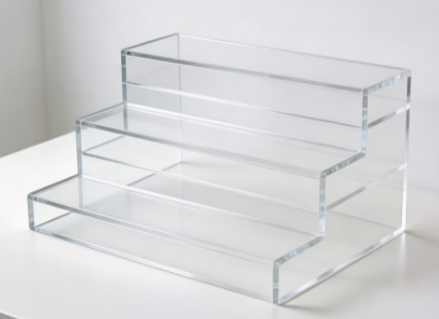
A purchasing manager at a cosmetics brand once told me she needed 5,000 acrylic display stands delivered within six weeks. The design was straightforward: an inclined shelf, a branded back panel, and a small drawer. Her first supplier proposed laser cutting plus solvent bonding. The unit price looked reasonable for small batches of a few hundred pieces, but the economics fell apart once scaled up to 5,000 units. Labor costs for fixture fabrication, bonding, and polishing every joint accounted for over half of each unit’s total cost. The lead time stretched to twelve weeks, as every single stand required separate curing time.
She thought she was facing a pricing issue, but the real problem lay in the manufacturing process. The component was not engineered for small-batch production, yet the order volume had grown far beyond the capacity of traditional assembly methods. Injection molding provided the solution—not because it is the only way to manufacture acrylic display stands, but because it is the sole method to mass-produce them without losing control over unit cost, quality consistency, and delivery lead time simultaneously.
Table of Contents
1. Volume Threshold: When Injection Molding Becomes the Optimal Solution
2. Material Properties of Acrylic for Injection Molding
3. Speed, Repeatability and the Unit Cost Curve
4. Direct Comparison: Injection Molding vs. Fabricated & Bonded Assembly
5. Achieving Optical Clarity at Mass Scale
6. Design Considerations for Injection-Molded Acrylic Display Stands
7. Frequently Asked Questions
8. Conclusion
Volume Threshold: When Injection Molding Becomes the Optimal Solution
Laser cutting and solvent bonding of acrylic sheets is the standard process for prototypes and low-volume orders (roughly 200–300 pieces or fewer). It requires no upfront mold investment, allows fast design revisions, and delivers predictable raw material costs. However, it follows a linear production workflow: every unit demands identical assembly labor hours. Labor time per unit remains unchanged whether producing 50 or 500 pieces. At 5,000 units, labor expenses alone can exceed the product selling price.
Injection molding operates on a non-linear production model. Precision steel molds represent the majority of upfront project expenditure—a fixed capital cost. Once this investment is made, the incremental cost for each additional unit only covers raw material and a few seconds of machine runtime. A single-cavity mold paired with a 150-ton injection molding machine can produce 60 to 90 display stands per hour. Multi-cavity molds can double or triple this output rate.
The mold amortization break-even point typically falls between 800 and 1,200 pieces for moderately complex display stands. Beyond this volume, the unit cost curve drops sharply. For quantities exceeding this threshold, injection molding delivers a 40% to 60% lower per-unit cost compared to bonded sheet assembly.
Material Properties of Acrylic for Injection Molding
Acrylic (Polymethyl Methacrylate, PMMA) is a thermoplastic with favorable melt flow under heat and pressure, yet it requires strict process control. Its melt viscosity is higher than polystyrene or ABS, meaning elevated injection pressure is required to fill thin-walled sections. Acrylic is also hygroscopic: any moisture absorbed by pellets prior to molding vaporizes inside the barrel, creating silver streaks and cloudiness that ruin the optical clarity for which acrylic is selected.
Material Handling Solution
Acrylic pellets for injection molding must be dried to a moisture content below 0.05% before processing, typically in a dehumidifying dryer at 80–90°C for 2 to 4 hours. Molding facilities that treat acrylic the same way as ABS will generate high scrap rates. Manufacturers that process acrylic as an optical-grade material produce finished parts requiring no secondary polishing.
Molds must also be engineered specifically for PMMA. Acrylic is notch-sensitive and prone to stress cracking, especially near sharp internal corners and gate locations. Generous radii, optimized gate placement, and controlled cooling rates are non-negotiable design requirements. A poorly engineered acrylic mold will produce stands that appear flawless upon shipment but develop fine cracks after three months on retail shelves. Cost-cutting on mold tooling compromises the entire quality control system—molds are the foundation of consistent product quality.
Speed, Repeatability and the Unit Cost Curve
Laser-cut, bonded acrylic display stands rely heavily on manual labor. Even with custom fixtures, dimensional consistency depends entirely on operator skill. Minor variations in adhesive dispensing, clamping pressure, and curing time create visible dimensional inconsistencies across finished units. For brands distributing identical products to hundreds of retail locations and thousands of shelf displays, such irregularities are visually obvious to consumers.
Injection-molded display stands are identical cycle after cycle. The mold cavity acts as a negative replica of the finished part, replicating the exact geometry to tolerances of thousandths of a millimeter every production cycle. Operators load raw pellets, and the machine automatically injects, cools, and ejects components in a repeating loop. No assembly labor is needed, and there are no failure-prone bonded seams. Parts are fully finished and ready for packaging immediately after ejection from the mold.
Combined speed and repeatability create decisive cost advantages at scale. A sheet-fabrication workshop assembling 50 stands per week occupies skilled labor that could be allocated to higher-value work. An injection molding plant producing 50 stands per hour eliminates this manual overhead, delivering higher output with drastically reduced quality inspection costs.
Direct Comparison: Injection Molding vs. Laser Cutting + Bonding
表格
Comparison Metric | Injection Molding | Laser Cutting & Solvent Bonding |
Upfront Investment | High (Tooling cost: $5,000–$20,000+) | Low (No mold tooling required) |
Unit Cost at 500 Pieces | High (Mold amortization dominates costs) | Moderate |
Unit Cost at 5,000 Pieces | Low (Typically $2–$8 per unit) | High (Typically $12–$25+ per unit) |
Initial Order Lead Time | 4–8 weeks (Mold fabrication + sample validation) | 2–4 weeks |
Reorder Lead Time | 1–2 weeks (Existing molds available) | Same as initial order (Linear labor dependency) |
Dimensional Tolerance | ±0.05–0.10 mm | ±0.25–0.50 mm (Operator-dependent) |
Optical Clarity | Excellent (Mirror-polished mold cavities) | Good (Polished edges with visible bonded seams) |
Joint Structural Strength | Monolithic single-piece construction (No joints) | Dependent on adhesive quality and surface preparation |
Design Complexity Capability | High (Undercuts, reinforcing ribs, snap-fit features supported) | Limited (Restricted to 2D cutting + manual assembly) |
Achieving Optical Clarity at Mass Scale
Acrylic is specified for display stands because it delivers glass-like transparency at half the weight of glass. Optical clarity is the most critical product specification. For injection molding, premium transparency is achieved through three interrelated factors: mirror mold polishing, precise melt temperature regulation, and strict contamination prevention.
Cavity surfaces for transparent acrylic components must be polished to mirror finish, generally SPI A-1 or A-2 surface grade. Even microscopic tool marks transfer to the part surface and scatter light, impairing clarity. Melt temperatures must be sufficiently high to enable full material flow and replicate the polished mold surface, yet not so high that polymer degradation occurs, which causes yellowing or black specks.
Contamination is the primary enemy of optical transparency. Foreign polymer particles, dust on mold surfaces, or residual purging compound left in the barrel create visible defects on transparent parts. Facilities regularly running clear acrylic allocate dedicated molding machines, or implement rigorous purging and cleaning protocols between material changeovers. Operations that skip these steps suffer excessive scrap rates that erase profit margins.
Design Considerations for Injection-Molded Acrylic Display Stands
Parts engineered for injection molding follow fundamentally different design rules compared to sheet-fabricated assemblies. Raw material, manufacturing process, and mold tooling must be designed in parallel.
1. Uniform Wall Thickness Acrylic shrinks during cooling. Uneven wall sections cool at different rates, generating internal residual stress that causes warpage or cracking. Standard wall thickness for display stands ranges from 2.5 mm to 4.0 mm, with smooth gradual transitions between varying cross-sections.
2. Mandatory Draft Angles Polished steel mold surfaces create high adhesion with acrylic. Insufficient draft angles result in surface scratches and marring during ejection. Recommended draft specifications: 0.5°–1° for textured surfaces, 1°–2° for high-gloss polished surfaces. Draft angles are not a design compromise—they are an essential manufacturing prerequisite for successful part ejection.
3. Reinforcing Ribs & Gussets Instead of Thick Solid Sections Rather than designing a 10 mm solid base, a 3 mm thin wall with integrated reinforcing ribs delivers equivalent structural rigidity while reducing raw material usage, accelerating cooling cycles, and minimizing shrinkage risks. The finished part is lighter, lower-cost, and dimensionally stable. Designers familiar with injection molding integrate these features from the initial concept stage. Designers without molding expertise often submit assembly-style drawings that are not manufacturable via injection molding, leading to unfeasible pricing requests.
Frequently Asked Questions
Q: At what order volume does injection molding become cheaper than bonded acrylic sheet fabrication?
A: The cost break-even threshold generally falls between 800 and 1,200 pieces, varying based on part complexity and total mold tooling cost. For orders below 500 units, sheet bonding is almost always more cost-effective. For volumes above 2,000 pieces, injection molding delivers clear advantages in unit cost, consistent quality, and faster reorder lead times.
Q: Can injection-molded acrylic match the optical clarity of cast polished acrylic?
A: Yes. When molds are finished to SPI A-1 mirror polish and pellets are fully dried to controlled moisture limits, injection-molded PMMA achieves equivalent optical transparency to cast acrylic. Proper mold design and maintenance eliminate the need for secondary polishing operations.
Q: Why do some injection-molded acrylic display stands develop cracks after several months of use?
A: The most prevalent root cause is residual molding stress, generated by uneven cooling, sharp internal corners, or poorly positioned gates. These internal stresses release gradually over time, forming cracks long after the product passes initial quality inspection. The permanent solution is revised mold design, not material substitution.
Q: Can recycled acrylic be used for injection-molded display stands?
A: Recycled PMMA is technically moldable, yet each thermal cycle degrades its optical performance and mechanical strength. For display stands where premium transparency and high-end appearance are core selling points, virgin resin is the industry standard specification. Recycled acrylic is better suited for hidden non-visible structural components.
Conclusion
When production volume becomes the primary cost driver, injection molding is the superior manufacturing process for acrylic display stands. It replaces manual assembly labor with precision mold tooling, eliminates quality variation through consistent repeatability, and delivers monolithic single-piece components with no secondary finishing requirements. The upfront investment in molds generates long-term returns: every unit ejected from the tool is identical to the last, with a per-unit cost unmatchable by manual sheet bonding at mass scale.
For purchasing managers managing five-figure order volumes, the core question is never whether injection molding is technically viable—it is whether the order quantity crosses the mold amortization break-even threshold. Once past this line, the cost savings per unit fully offset the initial tooling expense, and the manufacturing choice becomes self-evident. Below the threshold, you pay a premium for faster lead times that may not be required for smaller orders. Identifying this break-even volume for your specific part and order size separates strategic procurement planning from one-off transactional purchasing decisions.