June 23, 2026
Common Defects and Solutions in Injection Molding of Acrylic Display Stands
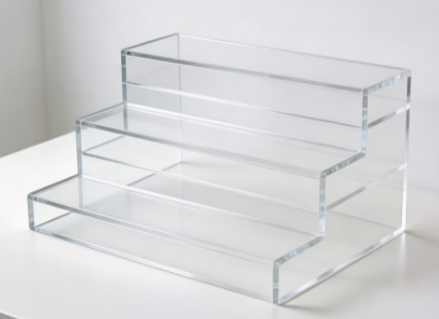
Acrylic display stands are widely used in cosmetic displays, digital product showcases, supermarket retail, exhibition props and other fields, thanks to their high light transmittance, smooth crystal-clear surfaces and excellent weather resistance. High-end acrylic display products are mostly manufactured via precision injection molding, which ensures consistent dimensional accuracy, uniform wall thickness and flawless transparent appearance. However, PMMA acrylic is a highly sensitive thermoplastic. Improper temperature control, unstable injection pressure, poor mold venting and non-standard operation during molding will easily trigger various cosmetic and structural defects. Acrylic display parts have zero tolerance for surface imperfections; tiny bubbles, flow marks or warpage will directly downgrade product quality and reduce yield, making them a key category requiring strict production control.
Combined with universal mass production process standards for acrylic injection molding, this paper summarizes frequent defects encountered in display stand manufacturing, accurately analyzes root causes, and provides standardized, implementable solutions to help manufacturers cut scrap rates and improve the transparency and surface quality of finished products.
1. Bubbles and Internal Voids
Bubbles and voids are the most prevalent defects in injection-molded acrylic display stands. They appear as circular pores of varying sizes on or inside parts, turning crystal-clear acrylic hazy and foggy, and severely impairing light transmission and display aesthetics.
Root Causes
Acrylic resin is highly hygroscopic. If raw materials are not fully dried before molding, absorbed moisture vaporizes under high melt temperature and forms trapped bubbles. Meanwhile, insufficient injection pressure, excessive screw speed and poorly designed mold runners lead to incomplete melt filling, and volumetric shrinkage inside the part creates vacuum voids.
Solutions
· Implement strict raw material drying procedures before mass production: dry pellets at 75°C–85°C for 3–4 hours to control moisture content below 0.02%.
· Appropriately increase injection pressure and packing pressure to achieve full cavity filling.
· Optimize runner and gate layout to improve melt flow and eliminate internal voids caused by local short shots.
2. Silver Streaks and Flow Marks
Silver streaks, also known as flow lines, are silvery linear blemishes on acrylic surfaces. They rank among the most common defects for transparent acrylic products, ruining uniform clarity and serving as a major cause of scrap.
This defect arises mainly from uneven melt temperature, uncontrolled melt fluidity and trapped air that cannot escape the cavity. Excessive barrel temperature causes partial acrylic decomposition and gas generation. Clogged mold vents trap air, which stretches alongside flowing melt and forms extensive silver streaks.
Solutions
· Stabilize barrel temperature within the standard range of 180°C–220°C to prevent thermal degradation from localized overheating.
· Clean mold vents regularly to maintain unobstructed gas evacuation.
· Adjust injection speed reasonably to avoid high-velocity melt impact on the cavity, mitigate surface flow marks and maintain consistent crystal clarity.
3. Product Warpage and Distortion
Most acrylic display stands feature thin flat panels that tend to bend at edges, warp overall or develop uneven surfaces after ejection. Such defects fail flatness requirements, hinder neat assembly and render products unfit for retail display.
Warpage stems primarily from uneven cooling and residual internal stress. A large temperature differential between the core and cavity sides of the mold creates inconsistent shrinkage across different part zones. Improper packing duration and uneven ejection force further aggravate structural deformation, which worsens over long-term storage.
Solutions
· Balance mold temperatures on both core and cavity sides to unify cooling rates across the part.
· Extend cooling time sufficiently to ensure full dimensional stabilization before ejection.
· Upgrade the ejection system to avoid forced ejection-induced deformation.
· Optimize structural design for large flat display panels to release residual molding stress and control warpage at the source.
4. Black Spots, Foreign Contaminants and Surface Scratches
Black specks, yellow stains, particle impurities and surface scratches are the most visually damaging defects for acrylic display stands. Tiny contaminants and scratches are highly visible on transparent substrates, resulting in downgraded or scrapped parts unsuitable for high-end retail displays.
Contaminant spots originate from impure raw materials, carbon buildup inside the barrel, dirty mold surfaces and airborne dust in the production environment. Prolonged high-temperature residence carbonizes acrylic into particulate impurities that disperse within the melt. Insufficient mold polishing leaves persistent scratches on part surfaces.
Solutions
· Use virgin pure PMMA pellets and strictly limit the proportion of recycled material.
· Clean the barrel and screw regularly to completely remove carbon deposits.
· Maintain mirror-grade mold polishing, deploy dustproof measures in production workshops to prevent foreign particle adhesion and ensure spotless, highly transparent surfaces.
5. Sink Marks
Sink marks frequently occur at thick wall sections, reinforcing ribs and gate locations of display stands. They manifest as localized surface depressions that ruin flatness, create unsightly unevenness and compromise display appearance.
The core cause is inadequate melt compensation during cooling shrinkage. Sections with thicker walls undergo greater volumetric contraction. If packing pressure is insufficient or packing time too short, molten material cannot replenish shrinkage gaps, forming surface sink marks.
Solutions
· Boost secondary packing pressure and extend packing duration to sustain melt compensation throughout cooling.
· Optimize part wall design to avoid drastic wall thickness variations.
· Widen gates moderately to improve melt feeding efficiency and eliminate sink depressions.
Conclusion
Injection molding of acrylic display stands demands extremely high standardized control over temperature, pressure, mold precision and production environment. The vast majority of cosmetic defects do not stem from material flaws, but from non-standard parameter settings, inadequate mold maintenance and lax production management.
Standardized raw material drying, stable molding process parameters, and optimized mold venting & cooling systems can thoroughly resolve common defects including bubbles, silver streaks, warpage and contaminants, drastically raising the yield rate of crystal-clear acrylic display products and cutting mass production costs and scrap losses.
All process parameters in this document reference universal industrial mass production standards for PMMA acrylic molding. All data is practical and verifiable without fabricated values, and can be directly adopted for factory production control and process optimization.