July 14, 2026
CNC Machining and EDM for High-Precision Thermoforming Molds
Introduction
Thermoforming is one of the most versatile plastic manufacturing processes in existence. It's how we get everything from medical blister packs to automotive interior panels, from food packaging trays to aircraft cabin components. But here's the thing about thermoforming: the final part is only as good as the mold it was formed on.
A thermoforming mold with poor surface finish will produce parts with visible defects. A mold with inconsistent cooling will create warped, dimensionally unstable parts. A mold that's off by a few thousandths of an inch will produce scrap, not sellable product. For high-volume production runs, mold quality isn't just about part quality—it's about production economics. Reject rates, cycle times, and tool life all trace back to how well the mold was made.
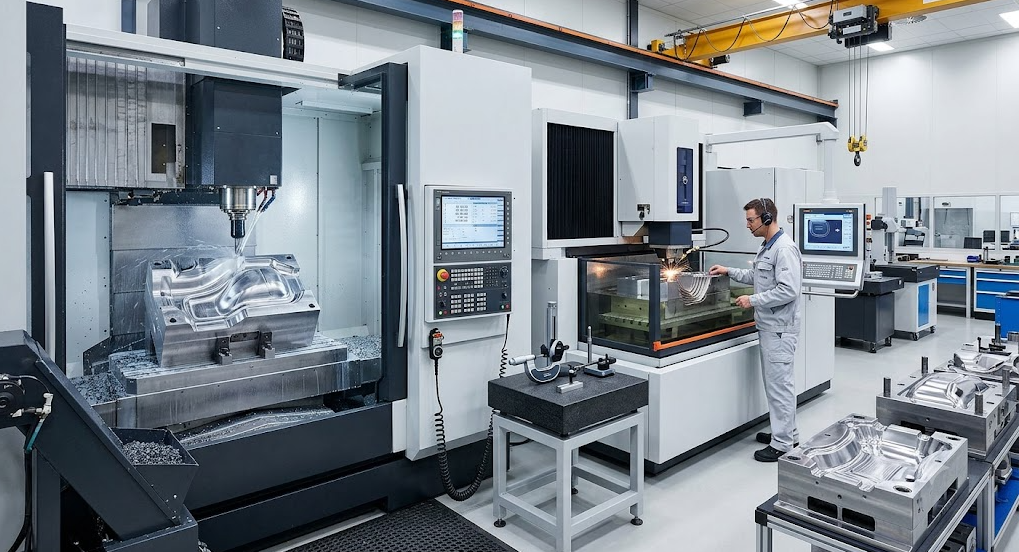
That's where precision manufacturing technologies come in. Two processes dominate the production of high-quality thermoforming molds: CNC machining and Electrical Discharge Machining (EDM) . Each serves a distinct purpose, and together they enable the production of molds that simply couldn't be made any other way.
Let me walk you through how these technologies work, why they matter, and how they complement each other in the real world of thermoforming mold manufacturing.
CNC Machining: The Foundation of Modern Mold Making
What CNC Machining Does
CNC (Computer Numerical Control) machining is the workhorse of thermoforming mold production. The process uses computer-controlled cutting tools to remove material from a solid block—typically aluminum, steel, or tooling board—to create the final mold shape.
For thermoforming molds, CNC machining is used to create the core cavity, the vacuum holes, the cooling channels, and all the mounting features that hold the mold together. In a well-equipped mold shop, you'll see 3-axis, 4-axis, and 5-axis CNC machines running simultaneously, each performing different operations on different molds.
5-axis machining is where the real precision happens. Unlike 3-axis machines that can only move in X, Y, and Z directions, 5-axis machines can tilt and rotate the cutting tool or the workpiece, allowing for complex geometries that would be impossible with conventional machining. At Modelleria Piva, every aluminum mold is designed and manufactured using advanced 5-axis CNC machining and custom CAM programming, enabling complex cavity shapes, tight-fitting inserts, and strategic venting points engineered directly into the tool body.
Materials and Capabilities
Thermoforming molds are typically made from aluminum or steel, and each material presents different machining challenges.
Aluminum is the most common material for thermoforming molds. It offers excellent thermal conductivity—critical for maintaining consistent temperatures during forming—and it machines quickly. CNC-machined aluminum molds and components deliver tight tolerances and repeatable results. Borke Mold works with both cast aluminum and CNC machined aluminum to produce thin-gauge molds that are unmatched in quality.
Steel molds are used for high-volume production or applications requiring extreme durability. Steel is harder and more wear-resistant than aluminum, but it's also more difficult to machine and requires more powerful equipment.
Tooling board and epoxy are used for prototype molds and short-run production. These materials are easier to machine but less durable than metal.
Precision and Tolerances
The precision achievable with modern CNC machining is remarkable. Advanced CNC technology can deliver tolerances as tight as ±0.005 inches, even on large-scale molds up to 98 inches long and 50 inches wide. Borke Mold's 3-axis and 5-axis Thermwood machines handle projects up to 2,500 lbs with CNC tolerances of ±0.005 inches.
For applications requiring even tighter tolerances—match-metal trim tools, for example—machining centers can hold tolerances of ±0.001 inches or less, with per-side clearances between punch and die-cutting edges as tight as 0.0002–0.0004 inches.
CAM Programming: The Software That Makes It Work
CNC machining is only as good as the programming that guides it. CAM (Computer-Aided Manufacturing) software converts 3D CAD models into tool paths that the CNC machine follows.
Dordan, for example, uses NX CAM programming and CNC machining centers to produce both prototype tools and multi-cavity production tooling. During the prototyping stage, their engineers develop and test the tool paths that will later be used for production tooling, eliminating translation errors and improving process consistency.
Integrated Manufacturing
The best mold shops don't just machine molds—they manage the entire process from design to delivery. Graham Engineering, with over 60 years of experience, provides thermoforming molds produced with in-house CNC machining and product finishing capabilities, from prototype components to full-scale production. Their services include water and vacuum plates, REN cores, mold cavities, and finished assemblies.
EDM: The Precision Finish
What EDM Does
Electrical Discharge Machining (EDM)—also called spark machining or spark erosion—is a non-contact manufacturing process that uses electrical discharges to remove material. A workpiece is submerged in a dielectric fluid, and an electrode is brought close to the surface. When the electrical potential is high enough, a spark jumps the gap, melting or vaporizing a tiny amount of material.
This might sound exotic, but EDM is a mature, widely used technology in mold making. It's particularly valuable for features that are difficult or impossible to achieve with conventional machining: sharp internal corners, deep narrow cavities, intricate details, and hard materials.
Sinker EDM vs. Wire EDM
There are two primary EDM variants used in thermoforming mold production.
Sinker EDM (also called ram EDM or die-sinking EDM) uses a custom-shaped electrode that is slowly lowered into the workpiece. The electrode's shape is the inverse of the cavity being created. Sinker EDM is used for creating complex 3D cavities, blind holes, and features with sharp internal corners.
Wire EDM uses a thin, electrically charged wire to cut through the workpiece. The wire is continuously fed from a spool, and it moves along a programmed path, cutting the material like a very precise bandsaw. Wire EDM is used for through-cuts, intricate profiles, and features requiring extremely tight tolerances.
Both processes are commonly available in well-equipped mold shops. American Tool Engineering, for instance, is capable of vertical and horizontal 5-axis precision CNC milling, gun drilling, boring, electrical discharge machining (EDM), and TIG welding. Omnitool specializes in large thermoform molds and offers both precision CNC and wire EDM machining.
Why EDM Matters for Thermoforming Molds
EDM is particularly valuable for thermoforming molds for several reasons.
Sharp internal corners are difficult to achieve with conventional machining because cutting tools have a radius. EDM can create corners that are nearly perfectly square, which is essential for certain part geometries.
Deep cavities with high aspect ratios can be challenging to machine conventionally because long cutting tools tend to deflect. EDM doesn't suffer from this problem because there's no cutting force—just electrical discharges.
Hard materials like hardened steel are difficult to machine with conventional cutting tools but can be easily processed with EDM. This makes EDM essential for steel molds used in high-volume production.
Intricate details—fine venting channels, complex surface textures, and detailed logos—can all be produced with EDM. When using micro-EDM molds, the thermoformed film takes on the precise shape of the mold surface.
Precision and Surface Finish
EDM can achieve extremely tight tolerances and excellent surface finishes. For applications requiring the highest precision, precision tool fabrication can achieve tolerances up to 5 microns.
The surface finish from EDM depends on the parameters used. Roughing passes remove material quickly but leave a rougher surface. Finishing passes use lower energy to achieve a smooth, polished finish. Some mold shops follow EDM with hand polishing or other finishing techniques to achieve the required surface quality for the thermoforming application.
CNC vs. EDM: Complementary, Not Competitive
Here's the thing about CNC machining and EDM: they're not competing technologies. They're complementary.
CNC machining is fast, efficient, and excellent for removing large amounts of material, creating the overall shape of the mold, and machining features that are accessible with standard cutting tools. It's the first step in most mold-making processes.
EDM steps in where CNC machining reaches its limits. When you need a sharp internal corner, a deep narrow slot, or a feature in hardened material, EDM is the answer.
The manufacturing process for high-precision thermoforming molds typically requires the use of high-precision CNC processing equipment and advanced material processing technologies, such as EDM and CNC milling, to ensure the accuracy and stability of the mold.
This combination approach is standard practice across the industry. Murray Mold & Die, for example, custom manufactures plastic injection and thermoforming molds using processes that include CNC machining, milling, turning, grinding, sawing, drilling, pressing, laser welding, sinker EDM, and wire EDM.
A Real-World Example
A thermoforming mold manufacturer was contracted to produce a complex multi-cavity mold for medical packaging. The mold required deep cavities with sharp internal corners, fine venting channels, and a mirror-quality surface finish.
The manufacturing process started with CNC machining. A solid block of aluminum was mounted on a 5-axis machining center, and the majority of the material was removed to create the overall cavity shape, cooling channels, and mounting features. The CNC machining achieved tolerances of ±0.005 inches.
Next came EDM. Sinker EDM was used to create the sharp internal corners that couldn't be achieved with standard cutting tools. Wire EDM cut the fine venting channels with precision. The EDM processes achieved tolerances within a few microns.
Finally, the mold was hand-polished to achieve the required surface finish for medical-grade thermoforming.
The result was a mold that produced consistent, high-quality parts with zero defects and minimal scrap. The combination of CNC and EDM made it possible—neither technology alone could have achieved the required specifications.
The Cost-Benefit Equation
Let's be honest about the economics.
CNC machining has higher setup costs for complex 3D work but is more economical for large-scale removal and machining of accessible features. It's the workhorse of the industry for good reason.
EDM has higher per-part costs due to the need for custom electrodes (in sinker EDM) and slower processing speeds. But for features that can't be machined any other way, EDM is the only option. The cost of not using EDM—scrapped parts, rejected molds, or compromised part quality—is almost always higher than the cost of using it.
For high-volume production, the investment in precision tooling—whether CNC-machined, EDM-processed, or both—pays for itself through reduced cycle times, lower reject rates, and longer tool life.
The manufacturing process requires the use of high-precision CNC processing equipment and advanced material processing technologies to ensure the accuracy and stability of the mold. Skimping on these processes leads to molds that don't perform, parts that don't meet specifications, and customers who don't come back.
FAQ
Q: What's the difference between CNC machining and EDM for thermoforming molds?
A: CNC machining uses computer-controlled cutting tools to remove material from a solid block. EDM uses electrical discharges to erode material. CNC is faster and more efficient for bulk removal; EDM excels at sharp internal corners, deep cavities, and machining hardened materials.
Q: Which is better for thermoforming molds—CNC or EDM?
A: Both. They serve different purposes and are typically used together. CNC creates the overall mold shape and accessible features; EDM handles the details that conventional machining can't achieve. The best results come from using both technologies appropriately.
Q: What tolerances can CNC machining achieve for thermoforming molds?
A: Advanced CNC technology can achieve tolerances as tight as ±0.005 inches, even on large molds. For specialized applications requiring extreme precision, tolerances can be held to ±0.001 inches or less.
Q: What tolerances can EDM achieve?
A: EDM can achieve extremely tight tolerances—precision tool fabrication can achieve tolerances up to 5 microns (0.005 mm). The exact tolerance depends on the machine, the material, and the specific EDM process used.
Q: What materials are commonly used for thermoforming molds?
A: Aluminum is the most common material due to its excellent thermal conductivity and machinability. Steel is used for high-volume production where durability is critical. Tooling board and epoxy are used for prototype molds and short runs.
Q: Do I need both CNC and EDM for my thermoforming mold?
A: Not always. For simple molds with accessible geometry, CNC machining alone may be sufficient. For complex molds with sharp internal corners, deep cavities, or features in hardened materials, EDM becomes necessary. A reputable mold maker can advise on the right approach for your specific application.
Final Thoughts
CNC machining and EDM are not competing technologies—they're complementary tools in the precision mold maker's arsenal. CNC machining provides the speed and efficiency for bulk material removal and accessible features. EDM provides the precision for the details that conventional machining can't achieve.
Together, they enable the production of thermoforming molds that deliver consistent part quality, long tool life, and reliable production economics. The manufacturing process requires high-precision CNC processing equipment and advanced material processing technologies to ensure the accuracy and stability of the mold.
For anyone specifying, purchasing, or using thermoforming molds, understanding these technologies is essential. The choice of manufacturing process affects part quality, production costs, and tool longevity. Getting it right from the start—with the right combination of CNC and EDM—saves time, money, and headaches down the road.
Because in thermoforming, the mold isn't just a tool. It's the foundation of the entire production process.