October 15, 2026
Preventing Oil & Solvent Degradation: Chemical Compatibility Testing of HDPE/ABS Trays with Stamping Lubricants
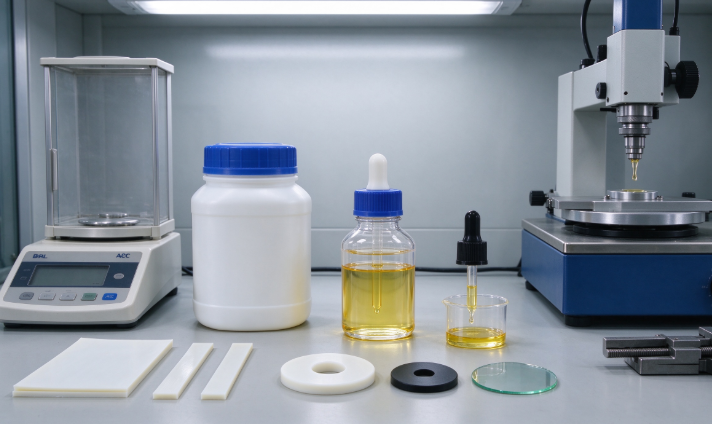
1. Introduction: The Tray Failure That Nobody Sees Coming
I have been specifying material handling trays for automotive stamping operations for over a decade, and I can tell you that the most expensive tray failure is not the one that cracks in half. It is the one that slowly swells, softens, and loses its dimensional stability over six months of exposure to stamping lubricant — and then drops a 15-kilogram stamped panel onto the floor.
The failure mechanism is chemical degradation, and it is almost always predictable. Stamping lubricants contain a complex mixture of base oils, extreme pressure additives, emulsifiers, corrosion inhibitors, and sometimes chlorinated or sulfurized compounds. When these chemistries contact a polymer tray surface repeatedly — through residual oil on stamped parts, through direct splash, or through immersion during cleaning — they can diffuse into the polymer matrix. The polymer swells. Mechanical properties decline. Dimensional tolerances drift. And the tray that passed every incoming inspection becomes a production hazard.
This is not a hypothetical risk. ABS consumer parts exposed to ester-based lubricants during assembly have experienced environmental stress cracking failures in documented industrial case studies. ABS polymers are described as being swollen by aromatic hydrocarbons and attacked by esters and ketones. And the failure is not always immediate — the degradation can progress for months before the tray becomes unusable.
What I want to do here is walk through the chemical compatibility testing framework that prevents these failures. Not a theoretical discussion of polymer chemistry, but a practical guide to the test standards, the degradation mechanisms, and the sourcing protocols that keep HDPE and ABS trays in service.
2. Why Stamping Lubricants Attack Plastic Trays
To understand why some trays fail and others survive for years, you need to understand what is actually in a stamping lubricant and how it interacts with polymer surfaces.
Stamping lubricants are formulated for metal forming, not for polymer compatibility. The primary components typically include a base oil — mineral oil, synthetic ester, or vegetable oil — combined with extreme pressure (EP) additives such as chlorinated paraffins, sulfurized fats, or phosphate esters. Emulsifiers, corrosion inhibitors, and friction modifiers complete the formulation. A typical water-based stamping lubricant may contain 5% to 30% oil phase dispersed in water with surfactant packages.
The compatibility problem comes from three sources. First, the base oil can diffuse into the amorphous regions of the polymer, causing swelling and plasticization. Second, the EP additives — particularly chlorinated and aromatic compounds — are aggressive toward styrenic polymers like ABS. Third, the emulsifiers and surfactants reduce surface tension, allowing the oil phase to wet and penetrate polymer surfaces more effectively than pure oil would.
There is also a temperature dimension. Stamping lubricants are often applied at elevated temperatures, and residual oil on freshly stamped parts can be 40°C to 60°C when the part contacts the tray. HDPE resistance to lubricating oil is rated Excellent at 20°C but only Fair at 50°C — a critical drop in performance at temperatures that are entirely realistic in a stamping operation.
The practical consequence is that a tray material that performs perfectly in a 20°C laboratory immersion test may fail in a 50°C production environment. This is why chemical compatibility testing must replicate the actual service temperature, not just ambient conditions.
3. HDPE vs. ABS: A Fundamental Chemical Resistance Comparison
HDPE and ABS have fundamentally different chemical resistance profiles, and understanding the difference is the starting point for any tray specification.
HDPE (High-Density Polyethylene) is a non-polar, semi-crystalline polymer with a tightly packed molecular structure. It does not easily react with acids, bases, salts, alcohols, glycols, or hydrocarbons including diesel and motor oil. HDPE is rated Excellent for lubricating oil resistance at 20°C, recommended for continuous use.
The limitation of HDPE is temperature. At 50°C, the rating drops to Fair — limited resistance, short-term exposure only. The maximum service temperature is around 80°C, and performance degrades significantly at higher temperatures. HDPE is also vulnerable to strong oxidizing acids, chlorinated solvents, and aromatic hydrocarbons.
ABS (Acrylonitrile Butadiene Styrene) is a terpolymer with a different chemical structure. The acrylonitrile component provides rigidity and chemical resistance; the butadiene provides toughness; the styrene provides surface finish and processability. ABS polymers are described as resistant to aqueous acids, alkalis, alcohols, and animal, vegetable, and mineral oils, but they are swollen by glacial acetic acid, carbon tetrachloride, and aromatic hydrocarbons and are soluble in esters, ketones, and ethylene dichloride.
The critical vulnerability of ABS is its limited resistance against oils and aromatic hydrocarbons — though this is still far better than polystyrene. More importantly, ABS is susceptible to environmental stress cracking (ESC) when exposed to oils under mechanical stress. Research has shown that ABS consumer parts exposed to ester-based lubricants during assembly experienced ESC failures. A study on ABS under oil exposure and static bending stress demonstrated that oil penetration into the polymer under mechanical load leads to fracture behavior that is fundamentally different from unstressed exposure.
The practical implication is that ABS trays are at risk whenever they carry stamped parts with residual lubricant, particularly if the parts are heavy and the tray experiences flexural stress. HDPE trays are more resistant to the lubricant chemistry itself but have a temperature limitation that must be respected.
Property | HDPE | ABS |
Chemical structure | Non-polar, semi-crystalline | Terpolymer (acrylonitrile/butadiene/styrene) |
Lubricating oil resistance (20°C) | Excellent — continuous use | Good to limited — depends on formulation |
Lubricating oil resistance (50°C) | Fair — short-term only | Limited — ESC risk under stress |
Aromatic hydrocarbon resistance | Poor | Poor — swollen by aromatics |
Ester/ketone resistance | Good | Poor — soluble in esters and ketones |
Environmental stress cracking risk | Low | High under oil + mechanical stress |
Maximum service temperature | ~80°C | ~85–95°C (depends on grade) |
Primary degradation risk | Temperature-driven softening | Solvent swelling + ESC |
4. The Four Degradation Mechanisms You Need to Test For
Chemical compatibility testing is not a single measurement. It is a series of measurements that detect four distinct degradation mechanisms. If your test protocol only checks one of them, you are missing three potential failure modes.
Mechanism 1: Swelling (dimensional change). When solvent molecules diffuse into the polymer matrix, the polymer swells. The dimensional change can be measured as thickness increase, length increase, or volume increase. For a tray with precision-molded cavities that must hold a stamped part at a specific position, even a 1% dimensional change can cause the part to shift or jam. Swelling is the earliest indicator of chemical attack, and it is reversible only if the exposure is stopped before permanent damage occurs.
Mechanism 2: Weight change (absorption). The mass of the tray increases as it absorbs lubricant. For HDPE, the weight change after immersion is typically less than 1% for lubricating oil at room temperature. For ABS exposed to aromatic or ester-based lubricants, weight gain can reach 5% to 15% depending on the formulation and exposure time. Weight change is a more sensitive indicator of absorption than dimensional change because the density of the absorbed lubricant differs from the polymer.
Mechanism 3: Mechanical property loss. Swelling and plasticization reduce the tray's mechanical properties. Tensile strength, flexural modulus, and impact resistance all decline. The tray may still look acceptable but fail under load. This is the most dangerous degradation mechanism because it is invisible to visual inspection.
Mechanism 4: Environmental stress cracking (ESC). This is the failure mode that specifically threatens ABS trays. ESC occurs when a chemical agent — in this case, the oil phase of the stamping lubricant — contacts a polymer that is under mechanical stress. The chemical penetrates the stressed polymer, weakening the intermolecular bonds and allowing cracks to initiate and propagate. The cracking can occur at stress levels well below the material's yield strength. ABS is particularly vulnerable to ESC from oils containing ester additives.
The practical test protocol must expose specimens to the lubricant under both unstressed and stressed conditions. Unstressed immersion tests (ASTM D543 Practice A) detect swelling, weight change, and mechanical property loss. Stressed exposure tests (ASTM D543 Practice B, or ISO 22088 for ESC) detect environmental stress cracking. A complete compatibility assessment requires both.
5. Test Standards: ASTM D543 and ISO 175 Explained
Two international standards govern chemical compatibility testing of plastics. They are complementary, not interchangeable, and both should be referenced in a sourcing specification.
ASTM D543-21, "Standard Practices for Evaluating the Resistance of Plastics to Chemical Reagents," is the primary U.S. standard. It provides three procedures: two under Practice A (Immersion Test) and one under Practice B (Mechanical Stress and Reagent Exposure under Standardized Conditions of Applied Strain). The choice of procedure depends on the end-use of the material. If the material is used as a container or transfer line — which describes a tray that holds oil-contaminated parts — immersion of the specimens is the correct procedure.
ASTM D543 measures changes in weight, dimensions, appearance, and mechanical properties after immersion in the chemical reagent. The test is conducted at a controlled temperature, and the exposure duration can be specified based on the intended service life. For a tray that contacts lubricant daily for years, an accelerated test at elevated temperature with a defined number of cycles is more representative than a single immersion test.
ISO 175:2010, "Plastics — Methods of test for the determination of the effects of immersion in liquid chemicals," is the international equivalent. It specifies a method of exposing test specimens to liquid chemicals and determining the changes in properties resulting from immersion. It considers testing by immersion of the entire surface of the test specimen. Notably, ISO 175 does not cover environmental stress cracking — that is addressed by the separate ISO 22088 series.
For a complete compatibility assessment, the test protocol should reference both standards:
·
ASTM D543 Practice A or ISO 175 for unstressed immersion testing (swelling, weight change, mechanical property loss)
·
·
ASTM D543 Practice B or ISO 22088 for stressed exposure testing (environmental stress cracking)
·
Test Standard | Scope | What It Measures | Best For |
ASTM D543 Practice A | Immersion test, unstressed | Weight change, dimensional change, appearance, mechanical properties | Baseline compatibility of material with lubricant |
ASTM D543 Practice B | Mechanical stress + reagent exposure | Environmental stress cracking under defined strain | Predicting ESC failure in ABS trays |
ISO 175:2010 | Immersion in liquid chemicals | Property changes after immersion | International projects, equivalent to D543 Practice A |
ISO 22088 (parts 1–6) | Environmental stress cracking | ESC resistance under various stress conditions | ESC testing for ABS and other susceptible polymers |
6. Head-to-Head: Compatibility Test Protocol Comparison
Test Parameter | HDPE Recommended Protocol | ABS Recommended Protocol |
Primary standard | ASTM D543 Practice A / ISO 175 | ASTM D543 Practice A + Practice B / ISO 175 + ISO 22088 |
Test temperature | 20°C and 50°C (service temperature range) | 20°C and 50°C (service temperature range) |
Exposure duration | 7 days, 30 days, 90 days | 7 days, 30 days, 90 days |
Critical measurements | Weight change, dimensional change, tensile strength retention | Weight change, dimensional change, tensile strength retention, ESC crack initiation |
Acceptance criteria (swelling) | < 1% dimensional change | < 1% dimensional change |
Acceptance criteria (weight) | < 1% weight gain | < 2% weight gain |
Acceptance criteria (mechanical) | > 80% tensile retention | > 70% tensile retention |
ESC resistance requirement | Low risk — visual inspection | No crack initiation after 30 days stressed exposure |
Lubricant type to test | Actual production lubricant (not generic oil) | Actual production lubricant (not generic oil) |
Surface preparation | All surfaces exposed — tray cavities included | All surfaces exposed — tray cavities included |
7. Designing a Chemical Compatibility Test Program
A chemical compatibility test program for tray specification must be designed around the actual service conditions, not a generic test protocol. Here is the framework I use.
Step 1: Identify the exact lubricant chemistry. Do not test with a generic "stamping oil." Request the full formulation — or at minimum the base oil type, EP additive package, and any chlorinated or aromatic components — from the lubricant supplier. Ester-based lubricants are the primary ESC risk for ABS. Aromatic hydrocarbon content drives HDPE swelling. The specific chemistry determines the specific risk.
Step 2: Define the service temperature. Measure the actual temperature of the stamped parts when they contact the tray. If parts come directly from the stamping press at 50°C or higher, the test must be conducted at that temperature. HDPE's lubricating oil rating drops from Excellent at 20°C to Fair at 50°C — the test temperature determines whether the material is suitable.
Step 3: Determine the exposure pattern. Are the trays immersed in lubricant during cleaning? Do they contact only residual oil film on stamped parts? Is there splash from the lubricant application system? The exposure pattern determines whether immersion testing (Practice A) or wet-patch testing is appropriate. For trays that contact oil-contaminated parts and are periodically cleaned with aqueous detergent, both the oil phase and the detergent phase must be tested.
Step 4: Include mechanical stress in the ABS test protocol. ABS environmental stress cracking occurs under mechanical load. An unstressed immersion test may show acceptable compatibility while the stressed tray cracks in service. For ABS trays, the test protocol must include stressed exposure — either via ASTM D543 Practice B or a custom fixture that applies a defined flexural strain to the specimen during lubricant exposure.
Step 5: Test with production-representative specimens. Flat test coupons do not capture the stress concentrations at tray cavity corners, rib intersections, or latch features. Where possible, test with sections cut from a production tray, including the molded features that are most likely to experience stress concentration.
Step 6: Define acceptance criteria before testing. Establish the maximum allowable swelling, weight gain, and mechanical property loss. A tray that swells 0.5% and retains 85% of its tensile strength is acceptable. A tray that swells 3% and retains 60% is not. The criteria must be tied to the functional requirements of the tray — dimensional tolerance, load capacity, and expected service life.
Test Step | Method | Duration | Key Measurement |
Lubricant characterization | Supplier formulation review | — | Base oil, EP additives, ester content, aromatic content |
Unstressed immersion (HDPE) | ASTM D543 Practice A | 7, 30, 90 days | Weight change, dimensional change |
Unstressed immersion (ABS) | ASTM D543 Practice A | 7, 30, 90 days | Weight change, dimensional change |
Stressed exposure (ABS) | ASTM D543 Practice B / ISO 22088 | 30 days | Crack initiation, ESC resistance |
Mechanical property retention | ASTM D638 (tensile) after exposure | After exposure | Tensile strength retention % |
Service simulation | Actual tray + lubricated parts, loaded | 30–90 days | Dimensional accuracy, visual inspection |
8. Case Study: The ABS Tray That Failed at 72 Hours
The most instructive case study for ABS chemical compatibility comes from industrial ESC research on consumer parts exposed to ester-based lubricants during assembly.
The documented case involved ABS components that were exposed to an ester-based lubricant/glue during an assembly process. The ESC failure mechanism was identified as the combination of chemical exposure and mechanical stress. The parts did not fail immediately. The degradation progressed over time — the lubricant diffused into the stressed polymer, the intermolecular bonds weakened, and cracks initiated at stress concentration points. By the time the failure was visible, the parts were already compromised.
The research on this case notes that examples of ESC from literature include the failure of automotive ABS/PC and ABS parts after exposure to PVC plasticisers or hydrocarbon oils containing an ester additive. This is directly relevant to stamping tray applications because many stamping lubricants contain ester-based base oils or ester additives. The ESC risk is not theoretical — it is documented in automotive applications.
A related study on ABS under oil exposure and static bending stress simulated ESC conditions by exposing ABS to oil under static bending stress. The fracture surface morphology was examined to observe fracture behavior associated with oil penetration. The key finding was that oil penetration under mechanical stress produced fracture behavior fundamentally different from unstressed exposure. The oil did not simply swell the ABS — it penetrated the stressed polymer, initiating cracks that propagated under loads well below the material's yield strength.
The practical lesson for B2B buyers is that an unstressed immersion test is insufficient for ABS tray qualification. The test must include mechanical stress that replicates the actual loading condition — the weight of the stamped parts, the flexural stress on the tray base, and the stress concentration at cavity edges. A tray that passes unstressed immersion testing may still fail in service if the stressed exposure test is not performed.
9. Practical Sourcing Framework for B2B Buyers
If you are sourcing HDPE or ABS trays for stamping lubricant contact, here is the framework I recommend.
Step 1: Match the material to the lubricant chemistry. If the lubricant is ester-based or contains aromatic hydrocarbons, ABS is a high-risk choice. HDPE is more resistant to these chemistries but has a lower temperature limit. If the service temperature exceeds 50°C, even HDPE requires careful validation.
Step 2: Request the lubricant formulation before specifying the tray. The tray supplier cannot select the right material without knowing what the tray will contact. Provide the base oil type, EP additive package, and any ester or aromatic content. If the lubricant supplier will not disclose the formulation, request a compatibility test from the lubricant manufacturer against candidate tray materials.
Step 3: Specify ASTM D543 testing in the purchase order. Require the tray supplier to provide ASTM D543 Practice A test data (immersion, unstressed) for both HDPE and ABS candidates against the actual production lubricant. For ABS, additionally require ASTM D543 Practice B or ISO 22088 stressed exposure data.
Step 4: Test at the actual service temperature. Specify the test temperature at 50°C if the parts contact the tray at elevated temperature. A room-temperature test does not predict high-temperature performance for HDPE.
Step 5: Include mechanical property retention in the acceptance criteria. Weight change and dimensional change are early indicators, but mechanical property retention (tensile strength, flexural modulus) is the definitive measure of whether the tray will survive under load. Specify a minimum of 80% tensile strength retention for HDPE and 70% for ABS after 30 days of lubricant exposure.
Step 6: Validate with a production trial. Laboratory testing is necessary but not sufficient. Run a production trial with actual lubricated parts in actual trays for a minimum of 30 days. Inspect the trays weekly for dimensional change, surface softening, cracking, and part fit. A tray that shows no visible change after 30 days of production exposure is a validated material.
Sourcing Parameter | HDPE | ABS |
Lubricant compatibility requirement | Excellent at 20°C, validate at 50°C | Validate with stressed exposure test |
Test standard | ASTM D543 Practice A / ISO 175 | ASTM D543 Practice A + Practice B / ISO 22088 |
Maximum swelling | < 1% dimensional change | < 1% dimensional change |
Maximum weight gain | < 1% | < 2% |
Minimum tensile retention | > 80% | > 70% |
ESC requirement | Not typically required | No cracks after 30 days stressed exposure |
Production trial | 30 days minimum | 30 days minimum |
Alternative material if fails | PP, PVDF | HDPE, PP, PC/ABS blend with ESCR grade |
10. Frequently Asked Questions
Q: Is HDPE or ABS better for stamping lubricant contact?
HDPE is generally more resistant to lubricating oil chemistry, with an Excellent rating for lubricating oil at 20°C. ABS has limited resistance to oils and is susceptible to environmental stress cracking when exposed to ester-based lubricants under mechanical stress. However, HDPE's performance drops to Fair at 50°C, so temperature is a critical variable. If the service temperature is elevated, neither material should be specified without compatibility testing.
Q: What is environmental stress cracking (ESC) and why does it matter for ABS trays?
ESC is a failure mechanism in which a chemical agent (such as the oil phase of a stamping lubricant) contacts a polymer that is under mechanical stress, causing cracks to initiate and propagate at stress levels well below the material's yield strength. ABS is particularly vulnerable to ESC from oils containing ester additives. An unstressed immersion test may show acceptable compatibility while the stressed tray cracks in service. For ABS trays, the test protocol must include stressed exposure testing.
Q: How do I test chemical compatibility between a tray material and a stamping lubricant?
The primary test standard is ASTM D543 for immersion testing (unstressed) and Practice B for stressed exposure. The international equivalent is ISO 175 for immersion and ISO 22088 for environmental stress cracking. The test should be conducted at the actual service temperature (typically 20°C and 50°C), with weight change, dimensional change, and mechanical property retention measured after defined exposure periods.
Q: What is an acceptable weight change for a tray after lubricant exposure?
For HDPE, weight gain after lubricating oil immersion should be less than 1%. For ABS, the acceptable limit is more difficult to define because weight gain can indicate ESC risk even at lower levels. A weight gain above 2% for ABS after 30 days of exposure is a warning sign that should trigger stressed exposure testing. The definitive criterion is mechanical property retention, not weight change alone.
Q: Can I use a generic stamping oil for compatibility testing instead of the actual production lubricant?
No. Stamping lubricants vary widely in base oil type, EP additive package, and ester content. A generic oil may be compatible with a material that the actual production lubricant attacks, or vice versa. The test must use the actual production lubricant — preferably the specific formulation from the specific supplier used in the facility.
Q: How often should chemical compatibility testing be repeated?
Whenever the lubricant formulation changes, whenever the tray material supplier changes, and at least once every two years as a baseline verification. Lubricant formulators can change base oils or additive packages without notice, and tray suppliers can change resin grades. Both changes invalidate previous compatibility test data.
Q: What alternative materials should I consider if both HDPE and ABS fail compatibility testing?
Polypropylene (PP) has chemical resistance comparable to or better than HDPE and a higher service temperature (up to 120°C). PVDF offers excellent chemical resistance across a broad range but at significantly higher cost. PC/ABS blends with ESCR grades are available for applications where ABS's mechanical properties are required but ESC resistance is improved. The choice depends on the specific lubricant chemistry and the tray's mechanical requirements.
11. Final Thoughts
Let me leave you with this.
Chemical compatibility failure in HDPE and ABS trays is not a random event. It is a predictable consequence of exposing a polymer to a chemistry it was not designed to resist, at a temperature it was not tested at, under a mechanical stress it was not qualified for. The failure may take months to become visible, but it is happening from the first day the tray contacts lubricant.
The data is clear. HDPE has excellent lubricating oil resistance at 20°C but only fair resistance at 50°C. ABS has limited oil resistance and is vulnerable to environmental stress cracking when exposed to ester-based lubricants under load. The test standards exist — ASTM D543 and ISO 175 for immersion, ASTM D543 Practice B and ISO 22088 for stressed exposure. The measurements are straightforward — weight change, dimensional change, mechanical property retention, and ESC crack initiation.
The problem is not that the technology is unavailable. The problem is that most tray specifications do not include a chemical compatibility testing requirement. The tray is selected on price, dimensional fit, and maybe impact strength. The lubricant compatibility is left to chance. And the failure surfaces six months later as a tray that has swollen beyond tolerance or cracked at a stress concentration point.
If you are sourcing trays for stamping lubricant contact, my advice is straightforward. Identify the lubricant chemistry. Test at the actual service temperature. Include mechanical stress in the test protocol for ABS. Require ASTM D543 or ISO 175 test data from the supplier. And validate with a production trial before committing to a full fleet.
The tray that passes every dimensional inspection on day one may still fail on day two hundred. Chemical compatibility testing is how you prevent that failure.