July 14, 2026
Applications of Precision Thermoforming Molds in the Construction Machinery Industry
Introduction
The construction machinery industry is built on heavy equipment—excavators, bulldozers, loaders, cranes. These machines operate in some of the harshest environments on earth: mud, dust, extreme temperatures, constant vibration, and physical impacts that would destroy lesser components.
For decades, the industry relied almost exclusively on metal for structural and protective parts. Steel was the default. It was strong, it was familiar, and it worked.
But the industry is changing. OEMs are under pressure to reduce weight, lower costs, accelerate production timelines, and improve operator comfort—all while maintaining or improving durability. And that's where precision thermoforming comes in.
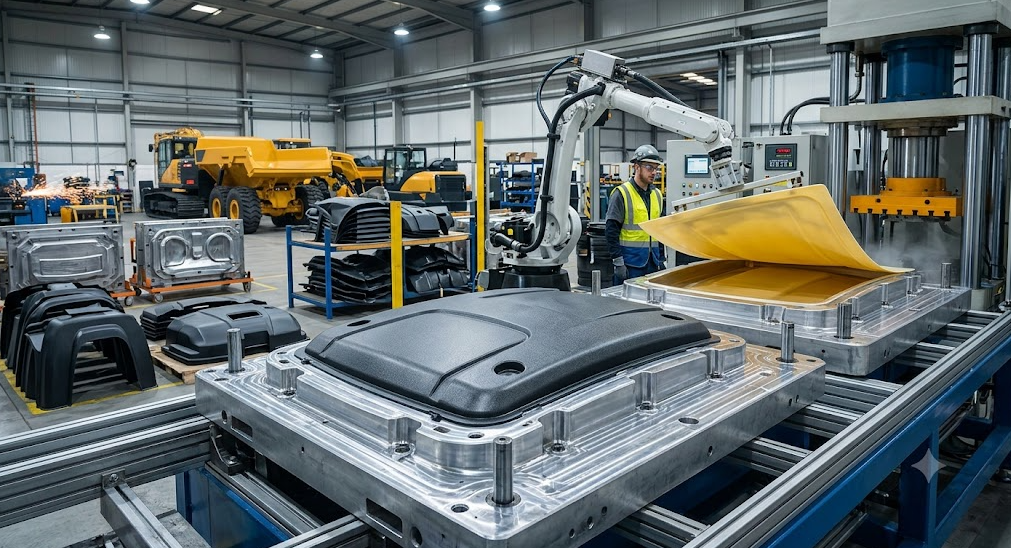
Thermoforming—particularly thick-gauge thermoforming—has emerged as a viable alternative to metal for a wide range of construction equipment components. The process uses large sheets of plastic (typically over 1.5mm thick) heated until pliable, then shaped around a custom mold using vacuum or pressure. The result is a part that's lighter, corrosion-resistant, and often less expensive than its metal counterpart.
This article explores how precision thermoforming molds are being applied across the construction machinery industry, the benefits they deliver, and what you need to know if you're considering the switch.
What Is Precision Thermoforming?
Before we get into applications, let's clarify what we're talking about.
Thermoforming is the process of heating sheets of plastic until the material becomes pliable, then shaping it over a mold using vacuum or pressure. Unlike injection molding—which requires expensive steel or aluminum tooling and is best suited for smaller, high-volume parts—thermoforming uses lower-cost tooling and is ideal for larger components.
In the context of construction machinery, we're typically talking about thick-gauge thermoforming (also called heavy-gauge or large-gauge thermoforming). This uses plastic sheets from 1.5mm to over 7mm thick and produces parts that are designed to exist for very long periods of time—not disposable items.
Precision thermoforming molds—whether machined aluminum, cast, or even 3D-printed—are the tools that give these large plastic sheets their final shape, detailing, curves, and angles. The quality of the mold directly determines the quality of the finished part.
Key Applications in Construction Machinery
Protective Guards and Covers
One of the most compelling applications for thermoformed plastics in construction equipment is replacing heavy metal guards and covers.
Consider a real-world example: a heavy equipment manufacturer had large metal belt guards covering the drive belt on one of their product lines. The metal guard weighed so much—approximately 718 pounds—that crews needed a forklift to remove it for daily belt inspections.
The solution was a thermoformed ABS part. The new guard weighed only 38 pounds—a weight reduction of nearly 95%. A single person could now remove the cover by hand. The time needed to service the equipment was cut in half. And the first prototypes were delivered three weeks before the deadline.
This is not an isolated case. Thermoformed plastic guards and covers are increasingly common for belt guards, engine covers, and access panels across the construction equipment industry. The plastics hold up better than metal in wet, dirty, or chemically exposed environments, and they don't dent or corrode like steel.
Interior Components
The operator's cabin is another major application area. Construction equipment cabins need to be durable, functional, and—increasingly—comfortable.
Thermoformed interior components include:
Dashboard panels and instrument clusters
Door panels and interior trim
Headliners and ceiling panels
Seat components and armrests
Storage compartments and cup holders
HVAC ducting and vent trim
The thermoforming process is particularly well-suited to these applications because it can produce large, complex shapes with integrated features—ribs, mounting points, and decorative textures—in a single part. This consolidation reduces assembly time and eliminates the fasteners and joints that can rattle loose over time.
Exterior Body Panels and Fairings
While not as common as interior applications, thermoformed exterior panels are gaining traction.
Fenders, hoods, side panels, and roof fairings can all be thermoformed from impact-resistant plastics. These parts need to withstand the abuse of the job site—rocks, debris, accidental impacts—while maintaining their appearance and structural integrity.
The advantages over metal are significant: no corrosion, no painting required (color can be molded in), lighter weight for better fuel efficiency, and lower tooling costs for new designs.
Electrical Enclosures and Control Boxes
Construction equipment is full of electronics—engine control modules, GPS systems, telematics units, and operator displays. All of these need protection from moisture, dust, and vibration.
Thermoformed enclosures offer several benefits:
Excellent dielectric properties (they don't conduct electricity)
Corrosion resistance in wet or chemically exposed environments
Customizable with mounting features, cable entry points, and seals
Lower tooling costs than die-cast metal enclosures
Fluid Management Components
Thermoformed plastics are also used for fluid management: reservoirs, tanks, and ducting.
While not suitable for high-pressure hydraulic systems, thermoformed parts work well for:
Coolant overflow tanks
Windshield washer reservoirs
Air intake ducts and hoses
HVAC ducting
The ability to form complex, three-dimensional shapes in a single piece eliminates the seams and joints that can leak in metal or multi-piece assemblies.
Specialized Components: Thread Protectors
A niche but critical application is thread protectors for drilling equipment.
In heavy industry and drilling, composite thread protectors are thermoformed to fit precision metal components. These protectors absorb impact and prevent thread corrosion in drills. The matching of plastic and metal parts requires absolute precision, which is why precision thermoforming molds are essential for this application.
Material Handling and Storage
Thermoforming is also used for custom material handling solutions: stackable trays, bins, and pallets with sections and ribbed interior walls. These are durable, reusable, and designed to reduce shipping and storage costs.
Materials Used in Construction Equipment Thermoforming
The material selection is critical. Construction machinery parts need to withstand impacts, UV exposure, temperature extremes, and chemical exposure.
Common materials for heavy-gauge thermoforming in construction applications include:
Material | Key Properties | Typical Applications |
ABS | High impact strength, good stiffness | Guards, covers, interior panels |
HDPE | Chemical resistance, toughness | Fluid tanks, exterior parts |
Polycarbonate (PC) | High impact resistance, clarity | Machine guards, windows |
PC/ABS blends | Balance of impact and heat resistance | Interior components, dashboards |
TPO | Weather resistance, flexibility | Exterior panels, fenders |
HMWPE | Extreme abrasion resistance | Wear parts, liners |
KYDEX® | Flame retardant, UV stable | Interior cabin components |
Flame-retardant and UV-stabilized formulations are available for outdoor and safety-critical applications. Many parts also incorporate custom branding, silk screening, painting, or special coatings and textures.
The Business Case: Why OEMs Are Switching
Cost Reduction
Thermoforming tooling costs are significantly lower than injection molding or metal stamping. For large parts, the tooling can be machined aluminum or even cast, which is far less expensive than the hardened steel dies required for metal stamping.
For smaller, one-time orders or low-volume production runs, thermoforming is often the only cost-effective option.
Weight Reduction
This is the headline benefit. Thermoformed plastic parts can weigh 50% to 90% less than equivalent metal parts. For mobile equipment, weight reduction translates directly to fuel savings, improved payload capacity, and reduced wear on suspension and drivetrain components.
Corrosion Resistance
Construction equipment operates in wet, muddy, and chemically aggressive environments. Metal rusts. Plastic doesn't. Thermoformed plastic parts eliminate the need for painting, galvanizing, or other corrosion protection measures.
Design Freedom
Thermoforming can produce complex shapes with integrated features—ribs for stiffness, mounting bosses, snap-fit details, and decorative textures. These features would require multiple metal components welded or bolted together, increasing assembly time and cost.
Faster Time to Market
Thermoforming tooling can be produced in weeks rather than months. For OEMs launching new products or making design improvements, this speed is invaluable.
Precision Requirements
Construction machinery components aren't toys. They need to fit precisely, function reliably, and withstand years of abuse.
Precision thermoforming molds are critical to achieving this. Key considerations include:
Tolerance control. Thermoforming is not as precise as injection molding—but with well-designed molds and controlled processes, it can achieve tolerances sufficient for most construction equipment applications. For applications requiring absolute precision—like thread protectors that mate with metal components—the mold quality is paramount.
Shrinkage compensation. Plastics shrink as they cool. Precision molds are designed to account for this shrinkage, ensuring the final part meets dimensional specifications.
Surface finish. The mold surface transfers directly to the plastic part. For parts with decorative or functional surface requirements, the mold must be finished accordingly.
Cooling and draft angles. Thermoformed parts need to release cleanly from the mold. Proper draft angles and cooling systems are essential for consistent production and part quality.
FAQ
Q: Can thermoformed plastic parts really replace metal in construction equipment?
A: Yes—for many applications. Guards, covers, interior panels, and enclosures are all viable candidates. The key is selecting the right material and designing the part for the thermoforming process. For structural load-bearing components, metal is still the default, but the range of suitable applications is expanding.
Q: Is thermoforming cheaper than injection molding?
A: For large parts and lower volumes, yes. Thermoforming tooling is significantly less expensive than injection molding tooling. For small, high-volume parts, injection molding is often more cost-effective per unit.
Q: What's the largest part that can be thermoformed for construction equipment?
A: Thermoforming presses can handle sheets up to 8 feet by 9 feet or larger. Draw depths of 10 to 12 inches are possible. Parts like hoods, roof fairings, and large guards are well within the capabilities of modern thermoforming equipment.
Q: How durable are thermoformed plastic parts compared to metal?
A: For impact resistance, thermoformed plastics—particularly ABS and polycarbonate—can match or exceed the performance of sheet metal. They don't dent, they don't corrode, and they absorb impact energy rather than transferring it. However, they have different failure modes (cracking vs. bending) and may not be suitable for all applications.
Q: What materials are commonly used for thermoforming construction equipment parts?
A: ABS, HDPE, polycarbonate, PC/ABS blends, TPO, and HMWPE are common. Each offers different balances of impact resistance, chemical resistance, temperature tolerance, and cost.
Q: How long does it take to develop a thermoforming mold?
A: Depending on complexity, mold development can take 4 to 8 weeks. This is significantly faster than the 12 to 20 weeks typical for injection molding or metal stamping tooling.
Final Thoughts
Precision thermoforming molds are transforming how construction equipment is built. Heavy metal guards are being replaced by lightweight plastics. Corrosion-prone steel panels are giving way to weather-resistant polymers. Complex assemblies of stamped and welded metal are being consolidated into single, thermoformed parts.
The trend is driven by practical realities: lower costs, faster production, reduced weight, and better durability in harsh environments. OEMs that embrace these technologies are gaining competitive advantages in speed, cost, and performance.
Thermoforming isn't a replacement for metal across the board. Load-bearing structural components still need steel. But for guards, covers, interiors, enclosures, and a growing list of other applications, precision thermoforming is not just viable—it's increasingly the preferred choice.
The mold is the key. A well-designed precision thermoforming mold produces parts that fit, function, and last. Get the mold right, and the rest follows.